Our Blog

Eating and Invisalign®

November 10th, 2016

One of the greatest advantages to using Invisalign is that it provides maximum results with minimal impact on your everyday life. Invisalign is comfortable, easy to insert, and simple to remove. Because you can remove Invisalign aligners, you can enjoy all your favorite foods and beverages without worries about getting food stuck in the wires and brackets of traditional braces.

Eating and Invisalign

While the aligner is durable and strong, you should remove it before you eat or drink beverages, as the chewing action inside your mouth can break, crack, or distort the aligner. Even minute damage to the Invisalign tray will prevent it from aligning your teeth properly. Furthermore, eating with Invisalign in your mouth can be quite messy.

Beverages and Invisalign

Repeated exposure to hot liquids may also cause the Invisalign aligner to distort. This distortion changes the shape of your aligner in a way that will affect how it straightens your teeth. Contact our Middleton, WI office if your Invisalign aligner has distorted after consuming a hot beverage.

Fluids can settle inside the aligner to “bathe” the teeth. Bathing teeth in acidic fluids can be especially problematic, as the acids can wear away tooth enamel. Exposure to acidic fluids is not normally a problem, as saliva neutralizes and buffers the acid then washes it away. Wearing an aligner, however, prevents the saliva from doing those jobs, increasing your risk for tooth decay.

Colored drinks may also change the color of your teeth. Most discoloration is temporary but stubborn stains may occur.

To prevent discoloration and tooth decay, brush your teeth after every meal or beverage before putting in your Invisalign aligners. If you do not have access to clean water, chew sugar-free gum to remove bacteria, acid, and food particles from your teeth. As a last resort, you may leave your aligners out for an hour or two until you can brush and floss properly. Before inserting Invisalign, rinse the aligner in lukewarm water or use the Invisalign cleaning kit.

Contact our Middleton, WI office for more information about eating and Invisalign.

Best Ways to Prevent Bad Breath

November 3rd, 2016

Nobody likes bad breath, and although it can sometimes be difficult to tell if you have it, it is always better to practice good oral health than risk having a smelly mouth. There are many ways to reduce or eliminate bad breath, some are definitely more effective and longer lasting than others. Check out ways to do so below.

Floss Regularly

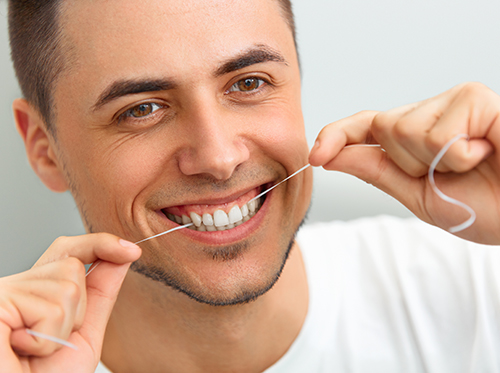
As difficult as it can be to remember to floss regularly, when it comes to bad breath, flossing is one of the easiest and most cost effective ways to freshen your mouth. See, flossing reduces the plaque and bacteria found in areas of your mouth that a toothbrush simply can't reach, and in turn, it rids your mouth of the smell associated with that bacteria. While flossing may not eliminate bad breath on its own, if you do it along with other health oral hygiene habits like brushing, then you may just develop a fresher smelling mouth.

Use Mouthwash

Using some sort of mouthwash can really freshen up your breath, especially if you find it still smells after brushing and flossing. There is a wide variety of mouthwash products on the market, however, you can also create your own by simply using baking soda mixed with water.

Always Brush after You Sleep

Whether after taking a nap, or having a full night of sleep, you will want to brush your teeth in order to reduce bad breath. The truth is, bacteria accumulates in your mouth while you are sleeping (even during a short nap) and that is ultimately the source of bad breath. So next time you wake from a good slumber, give your mouth some brushing and you will find it makes a big difference in the freshness of your breath.

There are many ways to freshen your breath beyond just using gum or mints, the above mentioned are just a few for you to try. Test them out and you will likely find your bad breath problem is solved, or at least considerably reduced. Of course, you can always ask Dr. Brad Hartjes and Dr. Joel Hartjes at your next visit to our Middleton, WI office.

The Intriguing History of Halloween

October 27th, 2016

Halloween is fast approaching, and Dr. Brad Hartjes and Dr. Joel Hartjes wanted to be sure to wish our patients a happy day, no matter how you might celebrate this holiday. The Halloween that is familiar to most people today bears little resemblance to the original Halloween; back in the "old days" it wasn't even called Halloween!

Festival of the Dead

Halloween started out as a Celtic festival of the dead that honored departed loved ones and signified a change in the cycle of the seasons. The Celtic people viewed Halloween, then called "Samhain," as a very special day – almost like our New Years day in fact, as their new calendar year began on November 1st. Samhain was the last day of autumn, so it was the time to harvest the last of the season's crops, store food away for winter, and situate livestock comfortably for the upcoming cold weather. The Celts believed that during this day, the last day of winter, the veil between this world and the spirit world is the thinnest, and that the living could communicate with departed loved ones most effectively on Samhain due to this.

Modern Halloween

Halloween as we know it today started because Christian missionaries were working to convert the Celtic people to Christianity. The Celts believed in religious concepts that were not supported by the Christian church, and these practices, which stemmed from Druidism, were perceived by the Christian church as being "devil worship" and dangerous.

When Pope Gregory the First instructed his missionaries to work at converting the Pagan people, he told them to try to incorporate some of the Pagan practices into Christian practices in a limited way. This meant that November 1st became "All Saints Day," which allowed Pagan people to still celebrate a beloved holiday without violating Christian beliefs.

Today, Halloween has evolved into a day devoted purely to fun, candy, and kids. What a change from its origins! We encourage all of our patients to have fun during the holiday, but be safe with the treats. Consider giving apples or fruit roll-ups to the kids instead of candy that is potentially damaging to the teeth and gums.

Remind kids to limit their candy and brush after eating it! Sweets can cause major tooth decay and aggrivate gum disease, so to avoid extra visits to our Middleton, WI office, make your Halloween a safe one!

What do I do if I fall and loosen my teeth?

October 20th, 2016

Although teeth are strong enough to tear through food, they are also fragile. An accident such as a fall may loosen teeth or knock a tooth out entirely. When a child loses a baby tooth in this manner, no permanent damage is usually done. However, adults who loosen permanent teeth may need to visit our Middleton, WI office.

The Anatomy of a Loose Tooth

The hard external layer of teeth covers a more vulnerable interior. The center of a tooth consists of the pulp, which contains blood vessels and nerves. The entire tooth extends below the surface of the gums into the jaw. Special tissue called cementum and the periodontal ligament hold teeth in place, preventing them from moving.

When a fall or blow to the face loosens a tooth, the tissues anchoring a tooth to the jaw may be damaged. This results in a loosened tooth that wiggles in place. There may be inflammation or bleeding of the gums, which signals dental damage.

Dental Treatments for a Loose Tooth

The range of dental treatments for loose teeth varies by the severity of the problem. If your teeth are just slightly loose following a fall, it may be fine to wait a few days. Teeth often retighten on their own. Simply avoid chewing with that tooth and enjoy softer foods for a few days.

If a tooth is very loose or nearly falling out, call Dr. Brad Hartjes and Dr. Joel Hartjes immediately. Immediate placement of the tooth back into the socket is needed to ensure its survival. In general, a tooth must return to its socket within two hours or it may be lost.

In some cases, Dr. Brad Hartjes and Dr. Joel Hartjes may recommend splinting, in which teeth are joined together to strengthen them and reduce strain on an individual tooth. Tightening or straightening the tooth can restore your ability to chew regularly without stressing the loosened tooth.

Regardless of the extent of the problem, it is essential to keep the tooth clean to prevent decay. Brush carefully with a soft-bristled brush, and use mouthwash regularly to kill bacteria.

1001 N Gammon Rd #2
Middleton, WI 53562
(608) 836-5600